


Walk into any nail supply aisle and you’ll see numbers like 80, 100, 180 and 240 printed on files and buffers. Those numbers tell you how coarse or fine the abrasive is, and choosing the wrong one can mean slow work on acrylics or damaged natural nails. This nail file grit guide explains what the numbers mean, which grit fits which job, and how salons can keep their tools organized and hygienic.

The right grit makes shaping faster and gentler on the nail.
What Does Nail File Grit Mean?
Grit describes the size of the abrasive particles on the file’s surface. The number roughly reflects how many particles fit in a square inch: the lower the number, the larger the particles and the coarser the file. The higher the number, the finer and smoother the surface.
- Low grit (around 80–100): coarse, removes material quickly
- Medium grit (around 150–180): shapes and refines with more control
- High grit (240 and up): fine, smooths and prepares for shine
Grit labels are not perfectly standardized across all products, so the same number can feel slightly different from one tool to another. Always test a new file on a practice tip before using it on a client.
Nail File Grit Chart: Which Grit for Which Job
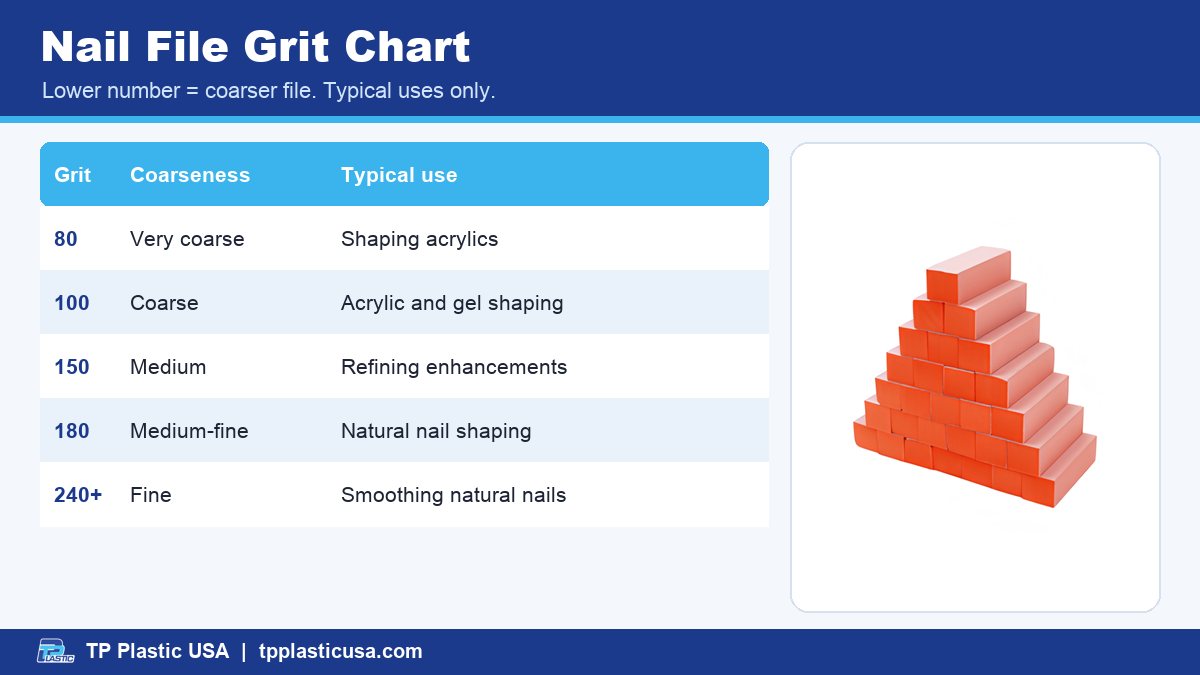
| Grit | Coarseness | Typical use |
|---|---|---|
| 80 | Very coarse | Shaping and shortening acrylics, reducing bulk |
| 100 | Coarse | Shaping acrylic and gel enhancements, refining length |
| 150 | Medium | Refining gel and acrylic, blending, surface prep |
| 180 | Medium-fine | Shaping and refining natural nails |
| 240+ | Fine | Smoothing natural nails, removing ridges, pre-buffing |
Many files are double-sided with two different grits, such as 100/180, so a tech can shape with one side and refine with the other. Some pedicure files use the same grit on both sides, like 80/80, for tougher jobs.
Grit Basics for Natural Nails vs Enhancements
Natural nails
Natural nails are thin and flexible. Coarse grits like 80 or 100 can fray the edge, cause peeling and thin the nail plate. For natural nails, most techs stick to around 180 for shaping and 240 or higher for smoothing the edge and surface. File in one direction rather than sawing back and forth.
Acrylic and hard gel
Enhancements are much harder than natural nails, so coarse grits make shaping efficient. An 80 or 100 grit removes bulk and sets the shape; a 150 or 180 grit then refines the surface before buffing and top coat. Keep coarse files away from the natural nail and the skin around it.
Feet and calluses
Pedicure work often uses coarser tools on the edges of toenails and on rough skin. Always go gently; over-filing skin can make it sore. For more on this, see our guides to the pumice pad and sanding bands.

Orange 3-way buffer, 80/80/80 grit, 500 per carton.
Understanding Buffers and Their Grit
Buffers are foam-core blocks covered with abrasive on several sides. Like files, their grit tells you what they are for. Coarser buffers help remove shine and prep a surface; finer buffers smooth ridges and add shine to natural nails.
- Our 3-way orange buffer is 80/80/80 grit, a coarse buffer suited to surface prep and tougher work.
- The 4-way buffer is 120/120/120/120 grit, measuring 3.74 x 0.98 x 0.98 in, a medium option for smoothing and prep.
- Compact options such as the long buffer and mini buffer are easy to control for detail work. Learn more in our 2-way mini buffer post.
Single-Use vs Multi-Use Files and Salon Hygiene
Files and buffers are porous, which makes them hard to clean thoroughly between clients. That’s why many salons give each client a fresh file and buffer, or send the used tools home with the client. Rules on which tools must be single-use, and how reusable tools must be cleaned, vary by state, so check your state board of cosmetology for the requirements that apply to your salon.
Practical tips for salons:
- Stock enough disposable files and buffers to cover your busiest days.
- Store unused tools in a clean, closed container, away from used ones.
- Use color or style to separate tool types, for example white files for one service and zebra files for another.
- Consider pre-packed kits to speed up setup; our disposable pedicure kits guide explains how salons use them.

Keep new tools in a clean, closed container, separate from used ones.
Our Files, Buffers and Kits
Here is how our products line up. Where we list a grit, it’s part of the product spec; where we don’t, check the product page before choosing it for a specific service.
- Premium nail files in white, zebra and gold, 50 per pack, 20 packs per carton.
- Manicure files such as the 5 in white wood file and 4.7 in zebra plastic file, 100 packs per carton.
- Pedicure Kit 4 PE includes a pumice pad, a 5 in zebra file (80/80), an orange buffer (80/100) and a PE toe separator, 200 sets per case. A Pedicure Kit 4 EVA version is also available.
- Manicure kit, 300 sets per carton.
For a wider look at stocking a salon, see bulk spa supplies for nail salons.
Frequently Asked Questions
What nail file grit is best for natural nails?
Most techs use around 180 grit for shaping natural nails and 240 or higher for smoothing. Coarser grits are usually too harsh.
Is 80 grit too rough?
For natural fingernails, usually yes. 80 grit is meant for shaping acrylics and tougher pedicure work, not thin natural nails.
Can nail files be reused between clients?
Many salons treat files and buffers as single-use. Requirements vary by state, so check your state board’s rules.
Stocking up for the salon? Browse all our nail products or request a quote for carton quantities.


