


Running out of can liners on a Friday afternoon is the kind of small problem that turns into a big one fast. A clear janitorial supply checklist helps facility managers and cleaning crews keep every office floor stocked with the right liners, gloves and aprons, without overbuying or cramming the storage closet. Use this guide to match liners to each bin, estimate monthly usage, and set simple par levels.
Start With a Walk-Through of Every Bin
Before you order anything, walk the building with a clipboard or phone and count every trash and recycling container. Note three things for each one:
- Location: desk, conference room, break room, restroom, copy room, lobby, loading area
- Size: measure the can or check the capacity label (in gallons)
- How often it is emptied: nightly, every other day, or several times a day
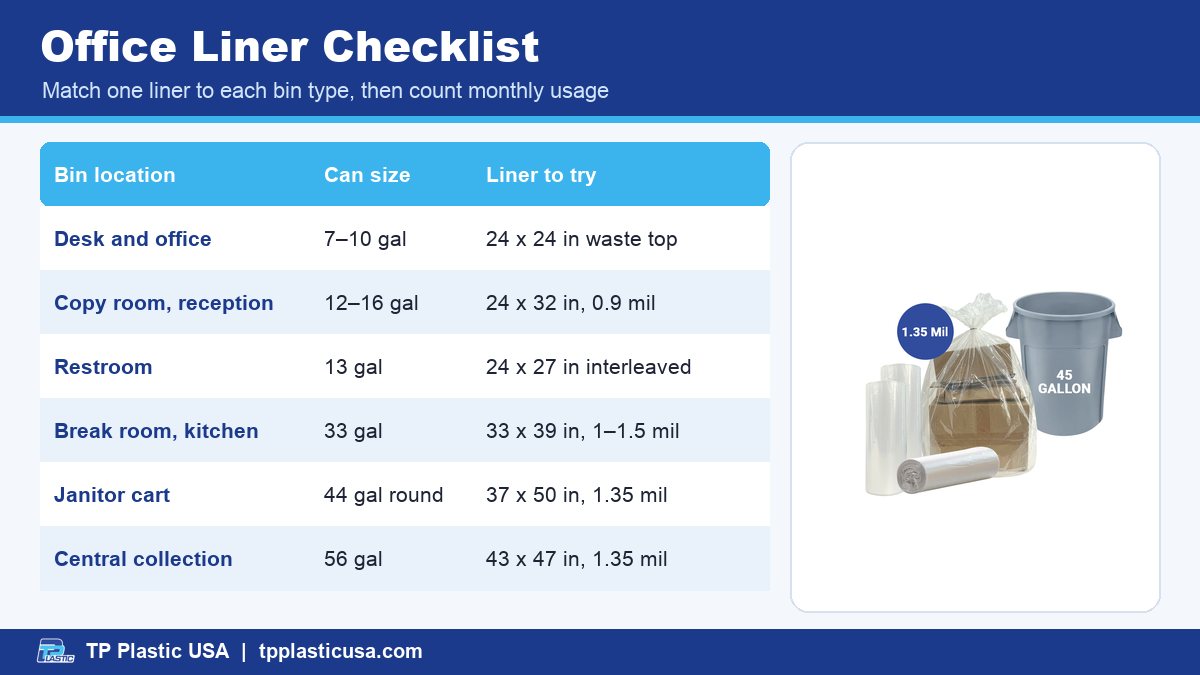
Most buildings end up with four or five bin types. Standardizing on one liner per bin type keeps ordering simple and helps crews grab the right bag every time. If you are not sure which liner fits which can, our trash can liner size chart lists common can sizes and matching bag dimensions.

Standardize one liner per bin type to keep carts simple.
Liners by Bin: The Core of Your Janitorial Supply Checklist
Desk and Office Bins (7–10 gal)
Under-desk bins mostly collect paper, so a light liner is enough. Our waste top bags are 24 x 24 in, 0.4 mil HDPE, 50 per roll, in clear or black. For slightly larger 12–16 gal bins in copy rooms or reception areas, try our 12–16 gal LD trash bags (24 x 32 in, 0.9 mil).
Restroom Bins
Restroom bins fill with paper towels and need to be changed quickly. Interleaved drawstring bags pull out one at a time, which saves time on a busy cleaning cart. Our 13 gal interleaved drawstring bags are 24 x 27 in, 16 mic, 22 per roll with 10 rolls per case.
Break Room and Kitchen Cans (33 gal)
Break rooms collect food scraps, coffee grounds and liquids, so step up in thickness. Options include black 33 gal bags (33 x 39 in, 1 mil, 25 per roll) and clear 33 gal bags (1.5 mil, 20 per roll). Clear bags are handy where staff need to see what is inside before the bag goes out.
Central Collection and Janitor Carts (44–56 gal)
Crews empty smaller bins into a large can on the cart, so this liner takes the most weight. For 44-gallon round cans, a 37 x 50 in bag fits most cans: we carry black and clear versions at 1.35 mil, 10 per roll. For bigger containers, our 56 gal black bags are 43 x 47 in, 1.35 mil.

Clear 37 x 50 in liners for janitor carts and central cans.
Gloves, Aprons and Other Essentials
Liners are only part of the list. Add these to your janitorial supply checklist:
- Disposable gloves: CPE gloves (22 mic) are a loose fit that slips on and off between tasks; TPE gloves are thinner and more flexible for detail work. Both come in M, L and XL. See our guide to buying disposable gloves in bulk.
- Disposable aprons: HDPE aprons (27 x 46 in, 16 mic, 100 per roll) protect uniforms during restroom and kitchen cleaning.
- Cleaning chemicals, paper towels, toilet tissue and hand soap from your regular supplier.
- Microfiber cloths, mop heads and spray bottles, with a replacement schedule.
- A spill kit for the break room and loading area.
How to Calculate Monthly Bag Usage
The simplest formula is:
Bins x changes per day x workdays per month = liners per month
Here is an example for a mid-size office open about 22 workdays a month:
| Bin type | Count x changes/day | Liners per month |
|---|---|---|
| Desk bins (7–10 gal) | 60 x 1 | 1,320 (about 27 rolls of 50) |
| Restroom bins (13 gal) | 8 x 2 | 352 (about 16 rolls of 22) |
| Break room cans (33 gal) | 4 x 2 | 176 (about 8 rolls of 25) |
| Cart and central cans (44 gal) | 6 x 1 | 132 (about 14 rolls of 10) |
Adjust the numbers for your building. If desk bins are emptied every other night, use 0.5 changes per day. If some bins only get a new liner when the old one is dirty, track actual usage for two or three weeks and use that number instead.

Set par levels and rotate older stock to the front.
Set Par Levels So You Never Run Out
A par level is the amount you want on the shelf at all times. A simple approach:
- Start with monthly usage from the formula above.
- Add a safety buffer of 15–25% for busy seasons, events and the occasional torn bag.
- Set a reorder point. When stock drops to about half a month’s supply, place the next order.
- Review every quarter. Headcount, cleaning schedules and building use change over time.
Ordering by the case usually means fewer deliveries and less paperwork. Our post on mistakes to avoid when ordering trash bags in bulk covers common traps like buying one liner size for every can.
Storage Tips for the Supply Closet
- Keep liners in their cases, off the floor, in a cool, dry place away from direct sunlight and heaters.
- Label shelves by bin type and liner size so anyone on the crew can restock correctly.
- Rotate stock: put new cases behind older ones and use the older stock first.
- Store gloves by size so crews do not grab the wrong one in a hurry.
- Keep the closet locked and keep plastic bags away from children if the building has a daycare or visitors.
Frequently Asked Questions
What size trash bags do most offices need?
Most offices use small liners for desk bins (7–10 gal), 13 gal bags for restrooms, 33 gal bags for break rooms, and 44–56 gal bags for janitor carts and central cans. Measure your cans to confirm.
How many trash bags does an office use per month?
Multiply the number of bins by the changes per day and the workdays per month. A 60-desk office can easily use over 1,000 desk liners a month, plus larger bags for restrooms and break rooms.
Should I use clear or black liners in an office?
Black liners hide contents and look tidy in public areas. Clear liners make it easier to check what is inside before the bag goes out. Many buildings use both.
Ready to stock your supply closet? Browse our trash bags or request a quote for case pricing.


