


The tall round utility can is a workhorse in commercial kitchens, warehouses, schools and on janitorial carts, and 44 gallon trash bags are what keep it running. Pick a liner that’s too narrow and it rips at the rim; pick one that’s too short and it slides into the can the moment it gets heavy. This guide covers the size that fits, the thickness to choose and a few tricks to stop bags from slipping.

Tall round utility cans need a liner long enough to fold over the rim.
What Size Are 44 Gallon Trash Bags?
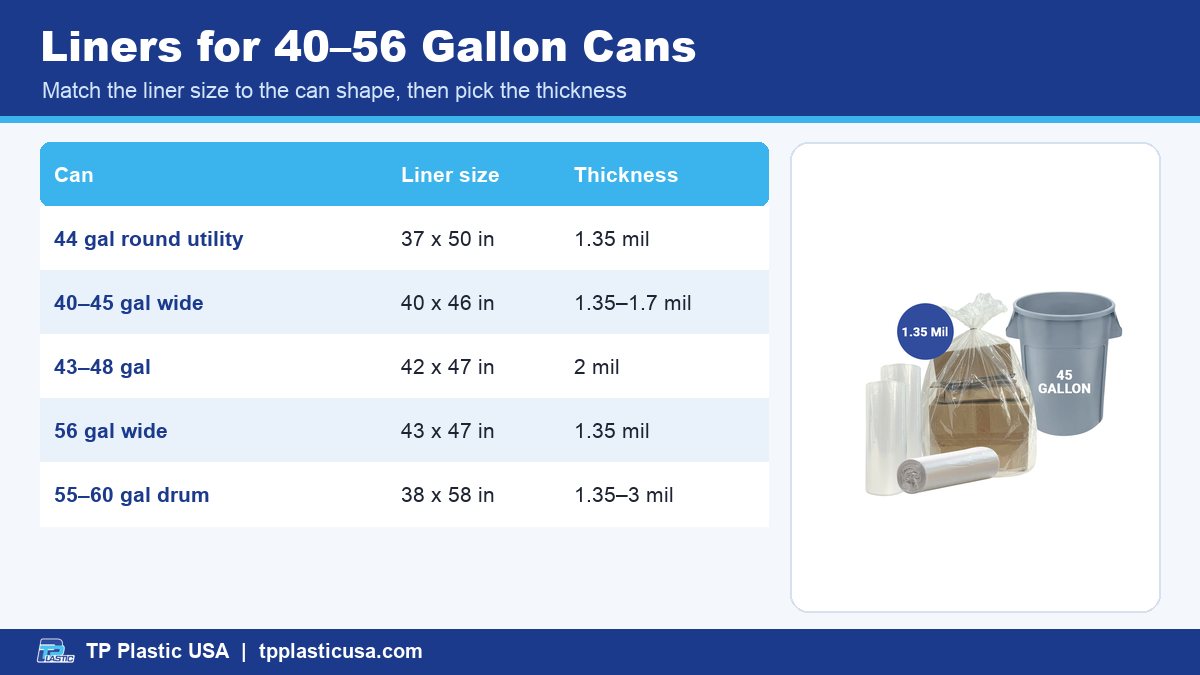
For most 44-gallon round cans, the liner size to look for is 37 x 50 in (flat width x length). That size gives enough width to stretch around the rim and enough length to reach the bottom with a few inches left to fold over the top.
You’ll also see bags described as “40–45 gallon” in a 40 x 46 in size. Those are wider and shorter, which suits wide square or shorter round cans better than tall utility cans. If your liners keep falling in, a 40 x 46 in bag in a tall 44 gal can is a common reason.
How to Check the Fit: A Simple Rule of Thumb
Can shapes vary between manufacturers, so it’s worth measuring once. You only need a tape measure.
Width
Measure around the outside of the can at the rim (the circumference). Your bag’s flat width x 2 should be at least that number, plus a little extra so the bag isn’t stretched tight. For example, a can about 24 in across has a circumference of roughly 75 in, so a bag 37–38 in wide is about right.
Length
Take the can height, add about half the diameter (so the bag can cover the bottom) and add 3–4 in of overhang. A can around 31–32 in tall and 24 in across works out to roughly 46–48 in, which is why a 50 in long liner leaves comfortable overhang.
For other can sizes, our trash can liner size chart lists common capacities and the bag sizes that usually fit.
Choosing Thickness for 44 Gallon Trash Bags
A big can holds a lot of weight, so thickness matters more here than in a small office bin. Low-density (LLDPE) liners measured in mil are the usual choice because they stretch before they tear, which helps with wet, heavy or bulky waste.
- 1.35 mil: a good everyday choice for kitchen waste, mixed trash and janitorial carts.
- 1.5–1.7 mil: for heavier, wetter loads or bags that get dragged.
- 2 mil and up: for construction debris, broken items and anything with sharp edges.
Still deciding? Our guide to heavy-duty trash bags for commercial and industrial use goes deeper into matching thickness to waste type, and the trash bag thickness guide explains mil and micron numbers.
Our 37 x 50 Liners and Alternatives
We carry 37 x 50 in liners that fit most 44-gallon round cans, plus wider sizes for 40–45 gal and larger containers:
- Black 37 x 50 in, 1.35 mil, 10 per roll, star seal, for kitchens, back-of-house and general waste.
- Clear 37 x 50 in, 1.35 mil, 10 per roll, for recycling areas or anywhere staff need to see what’s inside.
- Black 40 x 46 in, 1.35 mil for 40–45 gal cans, with heavier versions at 1.5 mil and 1.7 mil.
- Black 42 x 47 in, 2 mil for 43–48 gal cans that take a beating.
- Black 56 gallon, 43 x 47 in, 1.35 mil for wide cans and large collection bins.

Clear 37 x 50 in liners, 1.35 mil, 10 per roll.
Browse the full range in our LD trash bags category.

An even 3–4 in overhang helps keep the liner from slipping into the can.
How to Keep Liners From Slipping
Even the right size can slide in if it’s installed in a hurry. These habits help:
- Use the full overhang. Pull the bag down evenly so 3–4 in folds over the rim all the way around.
- Tie a loose knot in the overhang or tuck the extra under the rim on cans that have a lip.
- Push the air out. Press the bag down to the bottom before filling. Trapped air makes the liner balloon up and pull away from the rim.
- Check for vents. Many utility cans have vents near the base that let air escape so the bag doesn’t create suction when you lift it out. Keep them clear.
- Don’t overfill. Stop when the waste is a few inches below the rim so you can tie the bag without it slipping or tearing.
Where 44 Gallon Cans Work Best
- Restaurant kitchens: next to prep lines and dish areas where waste builds up fast.
- Janitorial carts: as the main collection bag when emptying smaller office and classroom bins.
- Warehouses and shipping areas: for packaging scraps, film and cardboard pieces.
- Schools and event spaces: in cafeterias and gyms.
A common reason bags fail in these spots is using a liner built for a different job. See why most trash bags fail for a quick check on your setup.
Frequently Asked Questions
Will a 40 x 46 in bag fit a 44 gallon can?
It may fit a wide 44 gal can, but on tall round utility cans it is often too short and can slip in. A 37 x 50 in liner is the safer choice.
What thickness do I need for kitchen waste?
1.35 mil LLDPE handles most mixed kitchen waste. Go to 1.5 mil or more if bags are often very heavy, wet or dragged.
Can I use 55–60 gallon bags in a 44 gallon can?
You can, but a 38 x 58 in bag leaves a lot of extra length, and you pay for plastic you don’t use. A liner sized for the can fits better.
Need liners for several sites? Request a wholesale quote and tell us your can sizes.


