


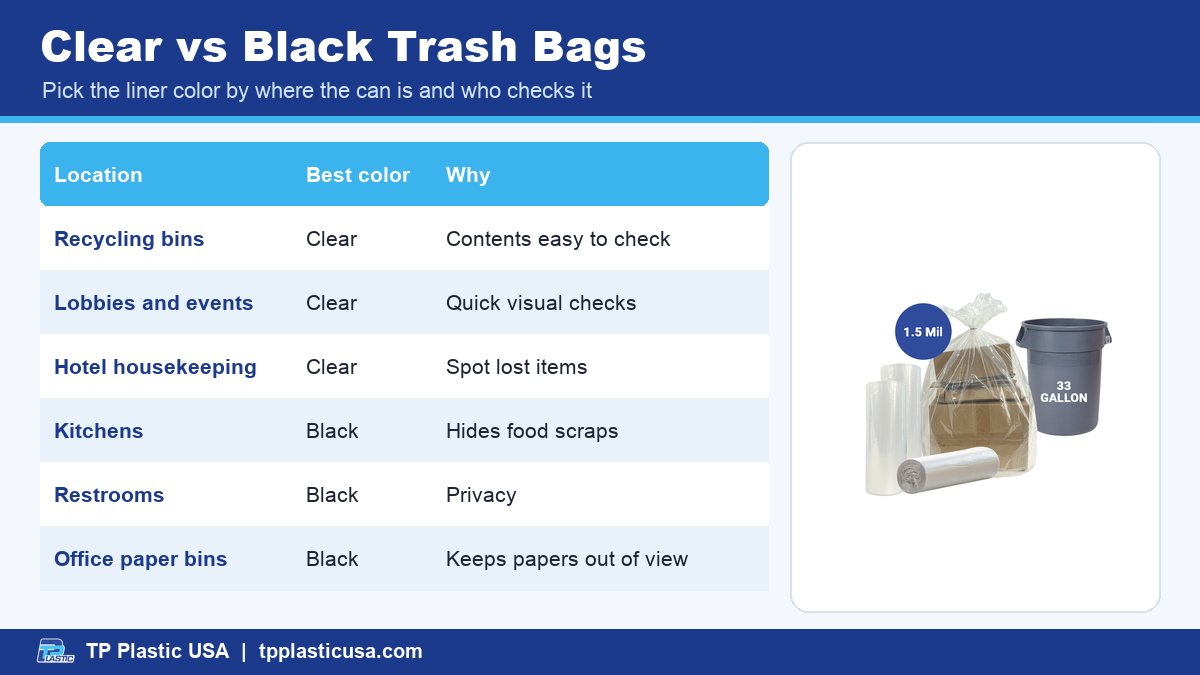
Most people grab black bags by default, but clear trash bags solve problems that black bags can’t. When staff, cleaners or collection crews need to see what’s inside a bag, a see-through liner saves time and prevents mix-ups. When the contents should stay private, black is the better call. This guide explains when to go clear, when to stick with black, and which sizes and thicknesses fit common jobs.

Clear liners show what's inside; black liners keep it out of view.
Clear Trash Bags vs Black Trash Bags at a Glance
Both colors can be made from the same material at the same thickness, so the real difference is visibility. Here is the quick version:
| Question | Clear bags | Black bags |
|---|---|---|
| Can you see the contents? | Yes, at a glance | No |
| Best for | Recyclables, lobbies, events, checks for lost items | Kitchens, restrooms, private or messy waste |
| Hides mess and odor-causing scraps? | No | Yes, visually |
| Helps catch sorting mistakes? | Yes | Not without opening the bag |
When Clear Trash Bags Make Sense
Recycling collection
Some buildings, property managers and local recycling programs ask for recyclables in see-through bags so collectors can confirm what’s inside without opening them. Rules vary a lot from city to city, so check your local program or hauler before you switch. If clear bags are requested, using them can help keep your recycling from being left behind.
Security and visual checks
Offices, schools, stadiums and event venues often prefer clear liners in public areas because staff can see the contents of a bag before it’s carried out. It’s a simple way to make routine walk-throughs faster.
Lost-item checks
Hotels, restaurants and offices regularly throw away things that were never meant to be trash: room keys, phones, silverware, glasses, paperwork. With see-through liners, housekeeping and dish crews can spot those items before the bag is tied and tossed.
Sorting and training
If your team separates cardboard, cans and general waste, clear bags make it easy for a supervisor to spot a wrong item in the wrong stream. That makes training quicker and keeps sorting habits consistent.
When Black Bags Are the Better Choice
Black liners hide what’s inside, which matters more than people think:
- Kitchens and food prep: food scraps, grease and packaging look messy through a clear bag.
- Restrooms: privacy is the main concern.
- Offices with paperwork: black bags keep printed documents out of view on the way to the dumpster (shred anything sensitive first).
- Customer-facing cans: a dark liner simply looks tidier when the bin is half full.
Many businesses use both: clear liners where checks or recycling matter, black liners everywhere else. If you’re still choosing the right bag for each job, our guide to choosing trash bags by capacity and thickness walks through the basics.
Clear Trash Bags Sizes and Thickness Options
Visibility is only half the decision. The bag still has to fit the can and hold the load. These are the clear liners we carry, all low-density (LLDPE) bags with a star seal bottom:
- Clear 33 gallon trash bags, 33 x 39 in, 1.5 mil, 20 per roll, for standard 33 gal cans with heavier mixed waste.
- Clear 33 x 40 in liners, 1.35 mil, 25 per roll, for everyday recycling and lobby cans.
- Clear 37 x 50 in liners, 1.35 mil, 10 per roll, which fit most 44-gallon round cans.
- Clear 56 gallon liners, 43 x 47 in, 1.35 mil, 10 per roll, for wide cans and large collection bins.

Clear 33 gallon trash bags let staff see the contents before the bag goes out.
For restroom and desk-side bins, the clear 10 gallon waste top bags (24 x 24 in, 0.4 mil) are a light option for paper and dry waste.
Matching Black Equivalents
If you want the same sizes in black for kitchens and restrooms, you can pair them like this:
- 33 gal, 33 x 39 in: black 1 mil, 25 per roll or black 1.5 mil for 33–38 gal cans.
- 37 x 50 in: black 1.35 mil, 10 per roll.
- 56 gal, 43 x 47 in: black 1.35 mil, 10 per roll.
- 20–30 gal, 30 x 36 in: black 1 mil, 25 per roll, for smaller kitchen and office cans.
You can browse the full range in our LD trash bags category. Not sure which gallon size fits your container? Check the trash can liner size chart before you order.

Clear bags make it easier to catch items that were thrown away by mistake.
Thickness Tips for Clear and Black Liners
Color doesn’t change strength. Thickness and material do. A few rules of thumb:
- Light, dry waste (paper, packaging, cans): around 1 mil or thinner is usually enough.
- Mixed or wet waste: step up to 1.35–1.5 mil.
- Sharp or very heavy debris: consider a heavier bag. Our comparison of contractor bags vs regular trash bags explains when to step up.
For a deeper look at mil and micron numbers, read our trash bag thickness guide.
Practical Tips for Using Clear Bags
- Label the bin, not just the bag. A simple sign above each can (“Recycling”, “General waste”) does more than color alone.
- Don’t overfill. Leave enough room to tie the bag so contents stay visible and the bag doesn’t split.
- Keep a few black bags nearby. If something messy ends up in a public can, a dark liner keeps it out of sight.
- Store rolls and loose bags away from children and pets.
Frequently Asked Questions
Are clear trash bags weaker than black trash bags?
Not by default. Strength comes from the material and thickness. A 1.5 mil clear LLDPE bag and a 1.5 mil black LLDPE bag are built for similar loads.
Do I have to use clear bags for recycling?
It depends on where you are. Some buildings and local programs ask for clear bags, while others don’t want recyclables bagged at all. Check your local rules or ask your hauler.
What size clear bag fits a standard 33 gallon can?
A 33 x 39 in or 33 x 40 in liner fits most standard 33 gallon cans. Measure your can if the shape is unusual.
Ready to stock up? Browse our trash bags or request a wholesale quote for clear and black liners.


