


“How many pallets will one roll wrap?” is one of the most common questions we hear from warehouse managers and small shippers. The honest answer is: it depends on your pallet size, load height, film width, overlap and how much you stretch the film. The good news is that you can estimate stretch film per pallet with simple math, then check it against a real test on your own floor. This guide walks you through the method, two worked examples and a quick reference table.

Consistent overlap and tension decide how many pallets a roll can cover.
The Four Numbers That Decide Stretch Film per Pallet
Before you do any math, gather these inputs:
- Pallet perimeter. A standard 48 in x 40 in pallet has a perimeter of 48 + 40 + 48 + 40 = 176 in, or about 14.7 ft. That is how much film one full revolution uses before stretching.
- Load height. Measure from the bottom deck of the pallet to the top of the load.
- Film width and overlap. Most operators overlap each layer by about 50% so there are no gaps. With 50% overlap, an 18 in film climbs about 9 in per revolution.
- Stretch. Hand film is usually stretched only about 20–50% by hand. Machine film on a powered pre-stretch carriage is often stretched 150–300%. Our pre-stretch ratio guide explains how this multiplies the usable length of a roll.
The Simple Estimating Formula
Use these three steps:
- Revolutions per pallet = load height ÷ (film width × (1 − overlap)) + 3 to 4 extra wraps for the base and top.
- Film used per pallet = revolutions × perimeter (in feet).
- Pallets per roll = (roll length × (1 + stretch %)) ÷ film used per pallet.
The extra base wraps matter. Locking the load to the pallet with two or three turns at the bottom is what keeps cartons from sliding off the deck, as covered in how proper stretch wrapping prevents load shifting. Skipping them to “save film” usually costs more in damaged freight.
Worked Example 1: 18 in x 1500 ft Hand Film
Let’s wrap a 48 x 40 in pallet stacked 60 in high using an 18 in x 1500 ft x 80 gauge clear hand film roll.
- Climb per revolution: 18 in × 0.5 = 9 in
- Revolutions to cover the height: 60 ÷ 9 ≈ 6.7, round up to 7
- Add 3 at the base and 2 at the top: about 12 revolutions
- Film per pallet: 12 × 14.7 ft ≈ 176 ft
With no stretch at all, 1500 ÷ 176 ≈ 8.5 pallets. If the operator stretches the film about 30% by hand, the roll behaves like roughly 1,950 ft, and 1,950 ÷ 176 ≈ 11 pallets. So a realistic estimate is about 8 to 11 pallets per roll for this load. Treat that as a planning number, not a promise, and confirm it by counting how many pallets your team actually gets from a few rolls.

Clear 18 in x 1500 ft x 80 gauge hand film, packed 4 rolls per carton.
Worked Example 2: 20 in x 5000 ft Machine Film
Now the same 60 in pallet on a turntable wrapper using 20 in x 5000 ft x 85 gauge machine film.
- Climb per revolution: 20 in × 0.5 = 10 in
- Revolutions to cover the height: 60 ÷ 10 = 6
- Add base and top wraps: about 12 revolutions in total (many machines also wrap back down)
- Film per pallet: 12 × 14.7 ft ≈ 176 ft of stretched film
At 150% pre-stretch, the roll delivers about 5,000 × 2.5 = 12,500 ft, or roughly 71 pallets. At 250% pre-stretch, it delivers about 17,500 ft, or roughly 99 pallets. That is why a single machine roll can replace a stack of hand rolls, and why hand vs machine stretch film is really a question of volume. Keep in mind that pre-stretched film narrows slightly, so actual coverage per revolution may be a little less than the math suggests.
Quick Reference: Approximate Pallets per Roll
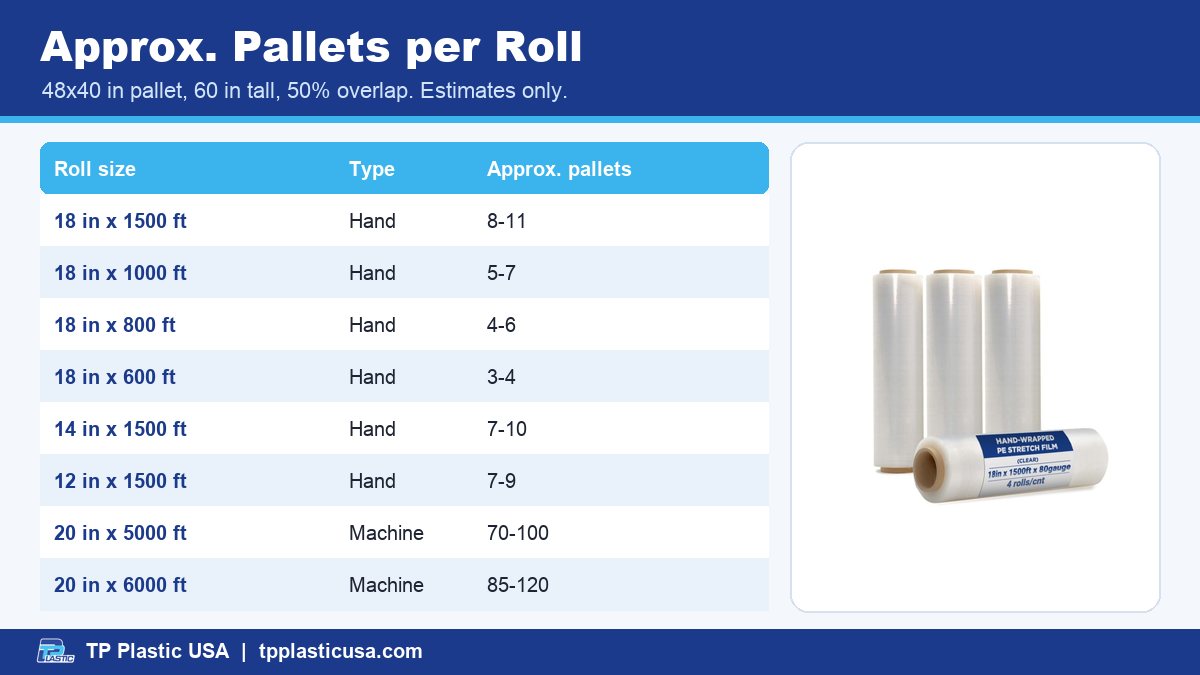
The table below uses the same assumptions: 48 x 40 in pallet, 60 in load, 50% overlap, 3 base and 2 top wraps. Hand film ranges run from no stretch to about 30% stretch; machine film ranges assume 150–250% pre-stretch. Your results will vary.
| Roll | Type | Approx. pallets per roll |
|---|---|---|
| 18 in x 1500 ft | Hand | 8–11 |
| 18 in x 1000 ft | Hand | 5–7 |
| 18 in x 800 ft | Hand | 4–6 |
| 18 in x 600 ft | Hand | 3–4 |
| 14 in x 1500 ft | Hand | 7–10 |
| 12 in x 1500 ft | Hand | 7–9 |
| 20 in x 5000 ft | Machine | 70–100 |
| 20 in x 6000 ft | Machine | 85–120 |
Narrow 12 in and 14 in rolls such as the 12 in x 1500 ft and 14 in x 1500 ft hand films are easier to handle but need more revolutions per pallet, so they are often used for bundling and smaller loads. Shorter rolls like the 18 in x 800 ft are lighter in the hand, which some teams prefer for occasional wrapping.

Powered pre-stretch lets one machine roll wrap many more pallets.
What Changes the Number in Real Life
Load height and shape
A 72 in load needs more revolutions than a 48 in load. Irregular loads with overhangs or sharp corners often need extra wraps, which lowers pallets per roll.
Film thickness
Thicker film (a higher gauge) does not change roll length, but it may let you use fewer revolutions on light, stable loads. If you are unsure which gauge to choose, see our stretch film thickness guide.
Wrapping pattern and tension
Extra “belly bands” in the middle, reinforcing the top tier, or wrapping with low tension all change how much film each pallet uses. Our overview of wrapping patterns covers these in detail.
Tips to Get More Pallets per Roll
- Stretch consistently. Train staff to walk backward with steady tension instead of letting the film sag.
- Keep overlap near 50%. Far more overlap wastes film; far less creates weak spots.
- Stop at the base wraps you need. Two or three solid base wraps are usually enough on stable loads.
- Stack pallets squarely. Cartons flush with the pallet edges use less film than loads with overhangs.
- Avoid common errors. Our list of common stretch film mistakes covers torn film, loose tails and over-wrapping.
- Match the roll to the job. High-volume lines usually save by moving to machine stretch film; lower-volume docks do well with hand stretch film.
Verify your estimate with a quick test
Pick a typical pallet, weigh a new roll, wrap five pallets the way your team normally does, then weigh the roll again. Divide the film used by five to get film per pallet, then work out how many pallets a full roll would cover. Repeat this whenever you change film, load type or staff. It is the most reliable way to budget stretch film per pallet and plan reorders.
Frequently Asked Questions
How many pallets does an 18 in x 1500 ft hand roll wrap?
For a 48 x 40 in pallet about 60 in tall, a rough estimate is 8 to 11 pallets, depending on how many wraps you use and how much the film is stretched.
Why does machine film wrap so many more pallets?
Machine rolls are much longer, and powered pre-stretch lengthens the film before it reaches the load, so each foot on the roll covers more pallet.
Does thicker film mean fewer pallets per roll?
Not directly, since roll length is what counts. Thicker film may allow fewer wraps on some loads, but check load stability before cutting back.
Ready to stock up? Browse our full range of PE stretch film or request a quote for carton or pallet quantities.


