


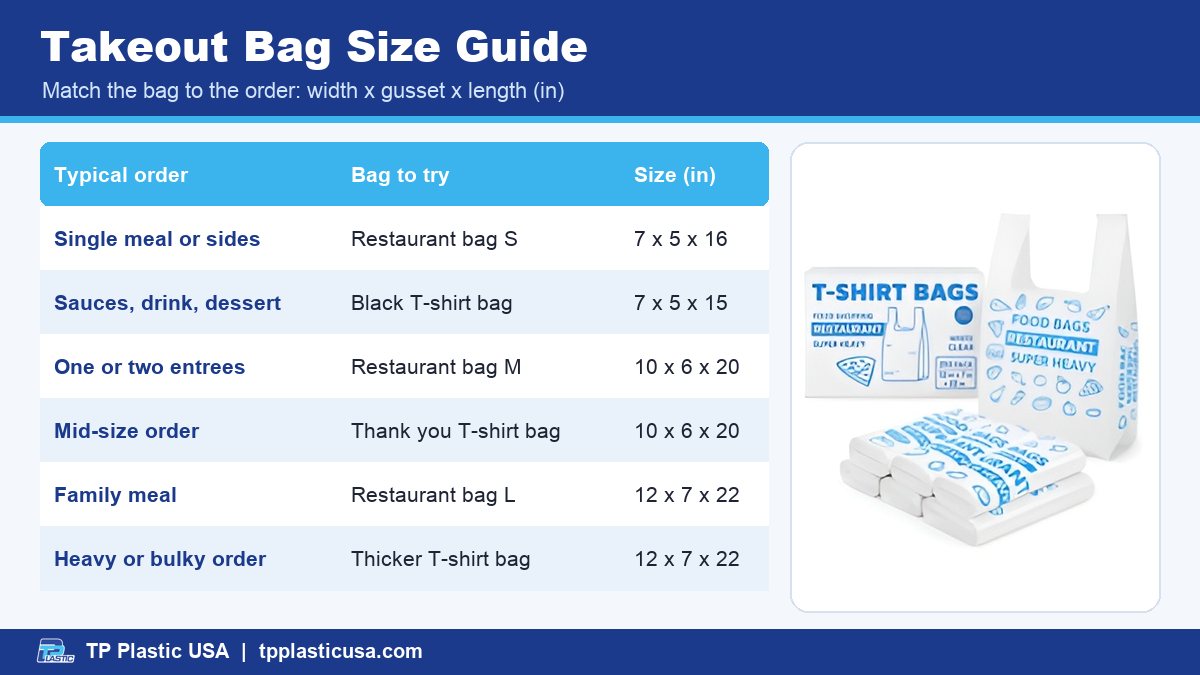
Takeout is a big part of almost every restaurant’s sales now, and the bag is the last thing your customer touches before they eat. Good takeout bags keep containers upright, hold the order without tearing, and make pickup and delivery handoffs faster. This guide walks through the main bag styles, how to read bag sizes, and how to match each bag to the orders you actually send out the door.
Why the Right Takeout Bags Matter
A bag that is too small squeezes containers and pops lids. A bag that is too big lets food slide around and tip over in the car. Either way, the customer opens a messy order and blames the kitchen, not the bag.
Picking two or three standard sizes also speeds up your line. Staff stop guessing, the pass stays organized, and you reorder on a predictable schedule instead of running out on a Friday night.

Standard bag sizes keep the pickup shelf organized.
The Two Main Types of Takeout Bags
HDPE Restaurant Bags
Our HDPE restaurant bags are made for food service. They come in three sizes, packed 250 pieces per case:
- Small: 7 x 5 x 16 in
- Medium: 10 x 6 x 20 in
- Large: 12 x 7 x 22 in
Three sizes cover most menus, from a single meal to a family order.

HDPE restaurant bags in three sizes for takeout and delivery.
T-Shirt Bags
T-shirt bags have two handles cut like the arms of a shirt, so they are quick to grab and easy to carry. Many restaurants, delis and food trucks use them for takeout. Options include:
- Black, no print: 7 x 5 x 15 in (2,000 pcs) and 11.5 x 6.5 x 22 in (1,000 pcs)
- “Thank you” print: 10 x 6 x 20 in, 12.5 mic (1,000 per case) and 11.5 x 6.5 x 22 in, 12.5 mic (1,000 per case)
- Thicker “Thank you” bags: 10.5 x 6 x 20 in, 0.6 mil (800 per box), 12 x 7 x 22 in, 15 mic (400 per box) and 12 x 7 x 22 in, 25 mic (300 per box)
For a closer look at T-shirt bags in a retail setting, see our guide to T-shirt bags for retailers.
How to Read Takeout Bag Sizes
Bag sizes are usually written as width x gusset x length. A 10 x 6 x 20 in bag is 10 in wide, has a 6 in side gusset (the fold that opens up to give the bag depth), and is 20 in long from the bottom to the top of the handles.
- Width decides how wide a container can sit flat on the bottom.
- Gusset gives depth, so stacked clamshells and round bowls fit without bulging the sides.
- Length includes the handles, so the usable height inside is shorter than the full number.
Thickness matters too. A higher micron or mil number means a thicker bag. For a 12.5 mic bag versus a 25 mic bag, the second is about twice as thick. Our T-shirt bag size guide has more sizing examples.
Matching Bag Size to Order Size
The easiest way to choose is to look at your top ten most common orders and test them in each bag size. As a starting point:
| Typical order | Bag to try | Size |
|---|---|---|
| Single meal or a couple of sides | Restaurant bag, Small | 7 x 5 x 16 in |
| Sauces, dessert or a drink add-on | Black T-shirt bag | 7 x 5 x 15 in |
| One or two entrees | Restaurant bag, Medium | 10 x 6 x 20 in |
| Mid-size order with sides | “Thank you” T-shirt bag | 10 x 6 x 20 in |
| Family meal or catering trays | Restaurant bag, Large | 12 x 7 x 22 in |
| Heavier or bulky orders | Thicker “Thank you” bag | 12 x 7 x 22 in |
If an order is heavy or has several hot containers, it is better to split it into two bags than to overload one. Customers notice when a bag feels secure.
Packing Tips for Hot, Cold and Flat Containers
Keep Flat Containers Flat
Clamshells, pizza-style boxes and meal trays should sit flat on the bottom of the bag. Choose a bag whose width and gusset are both a little larger than the container’s footprint. If the container has to tilt to fit, go up one size.
Separate Hot and Cold
Pack hot food and cold items like salads, drinks or ice cream in separate bags when you can. Heat and condensation from hot containers can make cold items soggy, and cold drinks cool down hot entrees. A small bag for drinks and desserts is a cheap way to keep both sides of the order at their best.
Heaviest Items on the Bottom
Put soups and heavy entrees at the bottom, lighter items like bread and sides on top, and napkins and utensils along the side. Tape or label lids on soups and sauces so they do not shift.

Keep flat containers flat and pack cold items separately.
Pickup Shelves and Delivery Apps
When orders sit on a pickup shelf, a few habits prevent mix-ups:
- Staple the receipt to the bag handles or fold the top and staple it closed with the receipt attached. Customers and drivers can confirm the order quickly, and the bag stays closed.
- Write the name or order number on a sticker or on the receipt in large letters, facing out.
- Use one bag size per order type where possible so staff can spot a family meal versus a single meal at a glance.
- Keep the shelf off the floor and away from the dish area.
Some delivery platforms and cities have their own rules about how orders are sealed or what bags may be used. Check your local rules and any platform requirements before you change your setup.
Plain Black or “Thank You” Print?
Plain black bags give a clean, simple look and do not show what is inside, which some customers like for pickup orders. “Thank you” print bags add a friendly touch at no extra effort for your staff. Many restaurants keep one of each: black for small add-on orders and printed bags for main orders.
For a wider look at bag styles, materials and printing options, see the buyer’s guide to plastic retail bags.
Before you reorder, keep bags in a cool, dry storage area away from the fryer and grill. Keep spare plastic bags out of reach of small children who may visit with their families.
Frequently Asked Questions
What size takeout bags should a small restaurant start with?
Most small restaurants do well with two or three sizes: a small bag for single meals and add-ons, a medium bag for one or two entrees, and a large bag for family orders. Test your most common orders before you settle on a mix.
Are T-shirt bags good for takeout food?
Yes. T-shirt bags are fast to load and easy to carry. For heavier orders, choose a thicker bag or split the order into two bags.
How do I keep containers from tipping in the bag?
Pick a bag with a gusset slightly wider than your containers so they sit flat, put heavy items on the bottom, and avoid bags that are much larger than the order.
Ready to stock up? Browse our restaurant bags and T-shirt bags, or request a wholesale quote for your location.


