


Buying the wrong glove size wastes money fast. Gloves that are too big slide off and get in the way; gloves that are too small tear and slow your team down. A simple disposable glove size chart and a soft tape measure solve most of these problems in a couple of minutes. Here is how to measure, what the typical sizes mean, and how to stock the right mix for a business.

Measure around the palm just below the knuckles, not including the thumb.
How to Measure Your Hand for Disposable Gloves
You only need a flexible tape measure (or a piece of string and a ruler). Measure your dominant hand, since it is usually slightly larger.
- Circumference: Wrap the tape around the widest part of your palm, just below the knuckles, not including the thumb. Keep your hand flat and relaxed.
- Length: Measure from the tip of your middle finger to the crease at the base of your palm.
- Use the larger number. Most charts are based on circumference. If your length is noticeably longer than typical for that size, consider going up a size.
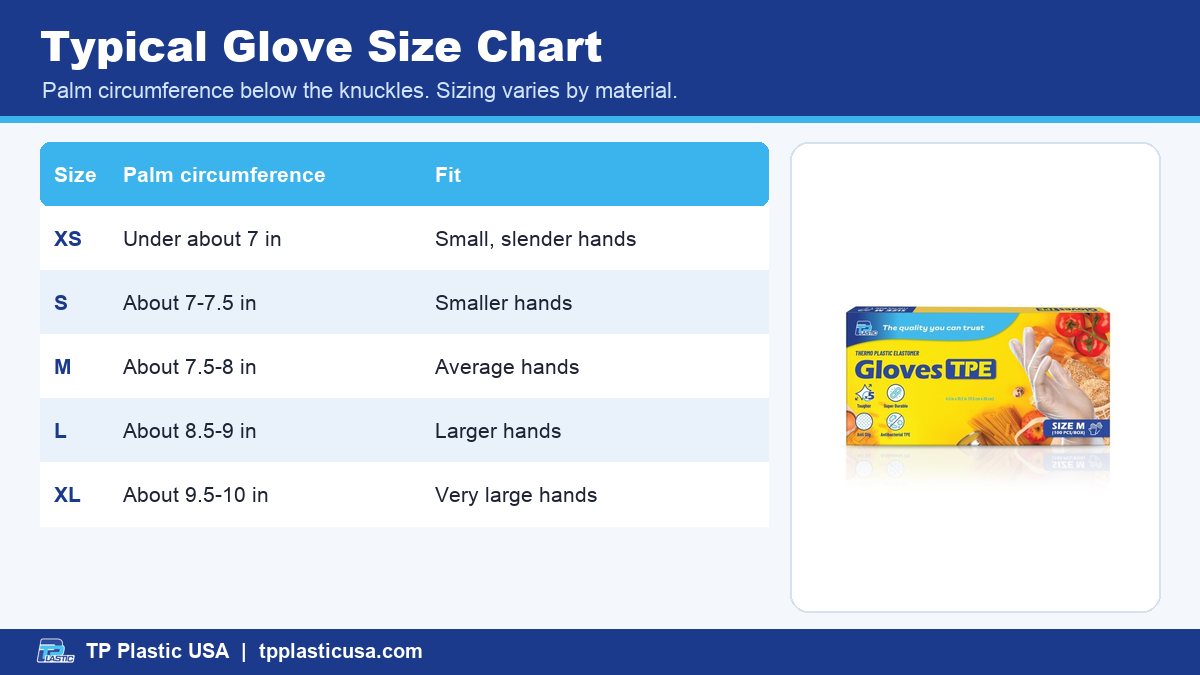
Typical Disposable Glove Size Chart
Sizing is not fully standardized, and it can vary by material and manufacturer. Use this chart as a typical guide, not an exact rule.
| Size | Typical palm circumference | Common fit |
|---|---|---|
| XS | Under about 7 in | Small, slender hands |
| S | About 7–7.5 in | Smaller hands |
| M | About 7.5–8 in | Average hands |
| L | About 8.5–9 in | Larger hands |
| XL | About 9.5–10 in | Very large hands |
Falling between sizes? For loose-fitting film gloves, size up. For close-fitting gloves like latex, try both sizes if you can and pick the one that lets you make a fist without tightness across the knuckles.
Why Glove Fit Matters
Too loose
Extra material at the fingertips makes it hard to pick up small items, peel labels or handle food neatly. Loose gloves can also slip off or catch on equipment. In food prep, a floppy fingertip can drag through food you didn’t mean to touch.
Too tight
A glove stretched over a hand that is too big for it thins out and is more likely to tear, especially at the base of the thumb. Tight gloves are also tiring to wear over a long shift and slow to put on.
Just right
A good fit has a little room at the fingertips, no strain across the palm, and a cuff that stays in place when you move your wrist. For more on how thickness affects feel and durability, see our disposable glove thickness guide.
How Fit Differs by Glove Material
Different materials fit very differently, so a “Large” in one type may feel nothing like a “Large” in another.
- CPE gloves are made from film and have a loose, relaxed fit. They slip on and off quickly, which is why they are popular for fast, frequent changes at deli counters and prep lines. Our CPE gloves are 22 mic “super-thick” film gloves in sizes M, L and XL.
- TPE gloves fit closer to the hand than CPE and feel more like a traditional glove, while still being easy to change. Our TPE gloves are “ultra-thin” and come in M, L and XL. Read the full comparison in TPE vs CPE gloves.
- Latex gloves stretch and hug the hand for the closest fit and best fingertip feel. Our latex gloves are offered in S and XS, 1,000 pieces per carton, which suits teams with smaller hands. Some people are sensitive to latex, so it’s smart to keep a non-latex option on hand. See latex vs nitrile for background.

TPE gloves in sizes M, L and XL, boxed in 100, 200 or 500.
Choosing Sizes for Your Staff
For a business, the goal is to cover everyone without buying cases of a size nobody uses.
- Measure your team once. A five-minute measuring session at a staff meeting gives you real numbers instead of guesses.
- Start with Medium and Large. In many workplaces, M and L cover most employees. Add XL for staff with larger hands and S or XS where needed.
- Stock by usage, not headcount. A person who changes gloves 20 times a shift needs far more than someone who wears them twice a day.
- Label storage clearly. Keep sizes on separate, labeled shelves or dispensers so nobody grabs the wrong box in a rush.
- Review every few months. New hires and changing tasks shift your size mix over time.
Box size helps too. High-use stations may prefer larger boxes, such as the TPE gloves, Medium, 200 per box or the TPE gloves, Large, 500 per box, while low-use areas can stick with 100-count boxes like the CPE gloves, Large, 100 per box. For planning larger orders, see our guide to buying disposable gloves in bulk.

A good fit makes gloves quicker to put on and easier to work in.
Glove Fit Tips for Everyday Use
- Dry your hands fully before putting gloves on; damp hands make gloves stick and tear.
- Remove rings and watches that can puncture thin gloves.
- Change gloves when switching tasks, and whenever a glove is torn.
- Store boxes away from heat and direct sunlight so the gloves stay in good condition.
- Pair gloves with a disposable apron for messy jobs.
Frequently Asked Questions
What size disposable glove does the average person wear?
Many adults fit a Medium or Large, but hand sizes vary widely. Measuring your palm circumference is the most reliable way to know.
Are glove sizes the same across brands and materials?
No. Loose film gloves like CPE fit very differently from stretchy latex. Use the chart as a starting point and test a box before ordering in bulk.
Should I size up or down if I’m between sizes?
For loose film gloves, size up. For close-fitting gloves, choose the size that lets you make a fist comfortably without strain.
Keep this disposable glove size chart handy when onboarding new staff, and re-measure anyone who complains about fit.
Ready to outfit your team? Browse our gloves and aprons or request a quote for case quantities in mixed sizes.


