


Table of Contents
ToggleThe New Formula for Smart Packaging
In today’s market, sustainability isn’t just a trend — it’s an engineering challenge.
Manufacturers and retailers want packaging that’s lighter, cheaper, and more eco-friendly — but customers still expect the same strength, durability, and performance.
The question is: how do you reduce plastic usage without compromising quality?
The answer lies in lightweight plastic packaging — a modern approach that combines material science, precision design, and advanced manufacturing to achieve the perfect balance between efficiency and strength.
At TP Plastic USA, we’ve refined this balance through years of R&D, creating packaging that’s thinner, stronger, and smarter — without sacrificing quality or usability.
1. What Is Lightweight Plastic Packaging?
Lightweight plastic packaging refers to packaging made using less material per unit — either by reducing film thickness or optimizing structure — while maintaining required performance levels.
It’s sometimes called “downgauging”, meaning that a product that used to be made at 30 microns can now perform equally well at 20 microns.
The key is not to simply “make it thinner,” but to engineer the material and design so that the bag maintains the same tensile strength, puncture resistance, and load capacity.
2. Why Lightweighting Matters
The benefits of lightweight plastic packaging go far beyond saving raw material. It has a direct impact on:
2.1. Environmental Sustainability
Uses fewer resources per bag → reduces overall carbon footprint.
Less weight means lower transport emissions.
Supports circular economy and EPR compliance goals.
2.2. Cost Efficiency
Less material = lower resin costs.
Fewer rolls or bags needed per shipment = reduced logistics expenses.
Higher production yield per ton of resin.
2.3. Performance Optimization
Enhanced flexibility and sealability through modern resin blends.
Greater customization for retail, trash, and industrial applications.
In short: doing more with less — a win for both business and the planet.
3. The Science Behind Lightweight Plastic Packaging
Achieving lighter yet stronger packaging is all about material behavior. Let’s break down the key scientific factors.
3.1. Resin Selection
Choosing the right resin blend is fundamental.
|
Resin Type |
Key Features |
Ideal For |
|---|---|---|
|
HDPE |
High stiffness, strength, low stretch |
Grocery bags, retail |
|
LDPE |
Flexible, glossy, sealable |
Mailer bags, liners |
|
LLDPE |
High toughness, stretchability |
Trash bags, starseal liners |
By blending LLDPE with LDPE or HDPE, manufacturers can create thin yet resilient films that outperform thicker single-resin options.
3.2. Co-Extrusion Technology
Modern lightweight films often use co-extrusion — layering two to five different resin compositions.
Each layer performs a function:
Outer layer: Strength and gloss
Middle layer: Bulk and impact resistance
Inner layer: Sealability and flexibility
This multi-layer structure distributes stress evenly and enhances overall performance even at reduced thickness.
3.3. Additives and Modifiers
Additives can fine-tune mechanical properties without adding extra material:
Metallocene LLDPE: boosts toughness and sealing at low thickness.
Slip agents: improve processability and film handling.
Anti-block agents: prevent sticking between layers.
UV stabilizers: increase durability under sunlight.
These enhancements make lightweight plastic packaging practical for real-world handling, not just lab performance.
4. Testing: Ensuring Performance Without Compromise
At TP Plastic USA, every downgauged product goes through a full strength validation process, ensuring it performs as well as — or better than — its thicker predecessor.
4.1. Tensile and Elongation Tests
Measure stretching and breaking point under stress (ASTM D882).
4.2. Dart Impact and Puncture Tests
Simulate real-world impacts such as drops or sharp edges (ASTM D1709).
4.3. Seal Integrity Tests
Confirm even sealing distribution across edges to prevent leakage.
4.4. Load Capacity Tests
Bags are filled to maximum expected weight until deformation or failure.
By collecting this data, we determine the minimum safe thickness — ensuring every product remains both functional and compliant.
5. Design Optimization Beyond Thickness
Reducing material doesn’t stop at film thickness. Bag design plays a critical role in achieving strength and usability.
5.1. Sealing Type
Starseal: Distributes weight evenly, prevents corner stress (best for trash bags).
Gusseted Seal: Expands capacity without extra film.
Flatseal: Economical for lightweight retail packaging.
5.2. Structural Geometry
Rounded edges and tapered gussets reduce stress points.
Proper bottom fold alignment minimizes film stretching during loading.
5.3. Handle Reinforcement
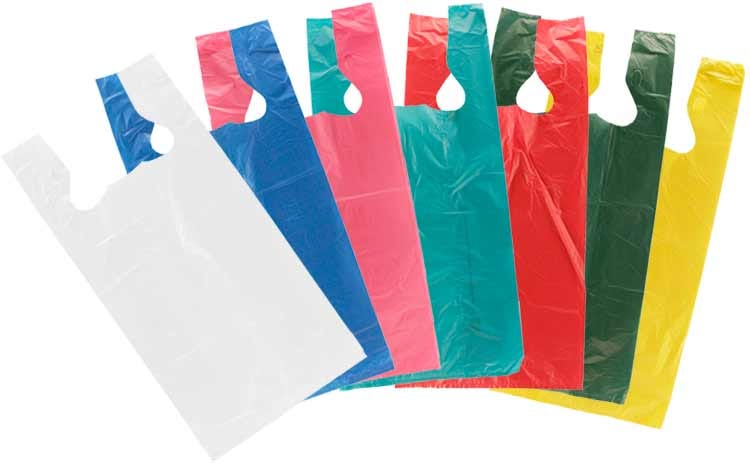
HDPE T-shirt bags often use dual-layer handles — increasing load strength without thickening the full film.
6. Lightweighting and Sustainability
Contrary to popular belief, thinner bags don’t necessarily mean more waste.
In fact, lightweight plastic packaging directly supports sustainability goals.
6.1. Reduced Carbon Footprint
Less resin = less fossil fuel extraction and lower emissions.
6.2. Easier Recycling
Mono-material or low-layer blends are more recyclable than laminated composites.
6.3. Resource Efficiency
One ton of resin now produces 20–30% more usable film — reducing waste across the supply chain.
6.4. Compatible With Recycled Resin
Many lightweight films can include up to 30–50% PCR or PIR content without performance loss, merging two sustainability solutions: lightweighting + recycling.
7. Case Study: The 25-Micron Challenge
When one of our U.S. retail clients requested a thinner grocery bag, TP Plastic USA redesigned their standard 35-micron LDPE film into a 25-micron LLDPE blend.
After testing:
Material usage dropped by 28%.
Dart impact strength remained above 350 g.
Seal performance improved by 15%.
Carbon emissions reduced by 20%.
This real-world project shows how lightweight plastic packaging isn’t about cutting corners — it’s about engineering smarter materials.
8. Common Myths About Lightweight Packaging
Myth 1: Thinner bags are weaker
→ Not true when using optimized blends and co-extrusion. Modern materials outperform older, thicker films.
Myth 2: Lightweight packaging feels cheap
→ Proper surface finishing (matte or gloss) and reinforced handles maintain a premium look and feel.
Myth 3: Lightweight means less eco-friendly
→ It’s actually more sustainable when designed properly, using fewer resources and generating less waste.
9. Global Standards and Certification
All lightweight films must still comply with global packaging and environmental standards:
|
Standard |
Scope |
|---|---|
|
ASTM D882 / D1709 / D1922 |
Strength, puncture, and tear tests |
|
ISO 14021 |
Recycled content & environmental claims |
|
ISO 18604 |
Material efficiency and recyclability |
|
EPR / DPP Compliance |
Traceability and waste reduction responsibility |
TP Plastic USA incorporates these standards into every OEM/ODM project — ensuring compliance for export markets in the U.S., EU, and Asia.
10. The Business Impact of Lightweighting
Lightweight plastic packaging isn’t just a green move — it’s a smart business strategy.
For brands and retailers:
Lower material and shipping costs.
Easier storage and transportation.
Enhanced sustainability credentials.
For manufacturers:
Higher efficiency in resin use.
Reduced energy and production time.
Easier alignment with ESG and client requirements.
This dual benefit — cost and compliance — makes lightweighting one of the most valuable packaging innovations today.
11. The TP Plastic USA Approach
Our lightweight design philosophy is built on three pillars:
Performance First – Every downgauged bag must meet or exceed original specifications.
Precision Manufacturing – Real-time film thickness control using automated sensors.
Sustainable Innovation – Integration of recycled and bio-based resins without compromising quality.
We apply these principles across all product lines — from HDPE grocery bags to LLDPE starseal liners — to ensure lightweight doesn’t mean fragile.
12. Future of Lightweight Plastic Packaging
As sustainability regulations tighten and resin technology advances, lightweight plastic packaging will continue evolving. Expect:
Smart resin blends using metallocene and bio-based polymers.
Digital quality tracking via QR-coded batch reports.
Full recyclability certification for mono-material packaging.
AI-driven extrusion systems optimizing film thickness in real time.
These trends show that lightweight packaging isn’t just the future — it’s the new standard of efficiency and responsibility.
Conclusion: Strength in Simplicity
Lightweight plastic packaging isn’t about doing less — it’s about doing better.
By understanding material science, optimizing design, and implementing precise testing, we can produce packaging that performs just as well with significantly less material.
At TP Plastic USA, we believe innovation doesn’t always mean adding more — sometimes, it means removing the unnecessary to reveal smarter, stronger, and more sustainable solutions.
Because less can truly be more — when it’s designed right.
TP Plastic USA – The quality you can trust.
Website: tpplasticusa.com / truongphuocplastic.com
Email: contact@tpplasticusa.com
Zalo/WhatsApp: (+1) 818 914 0351 / (+84) 915 871 722


