


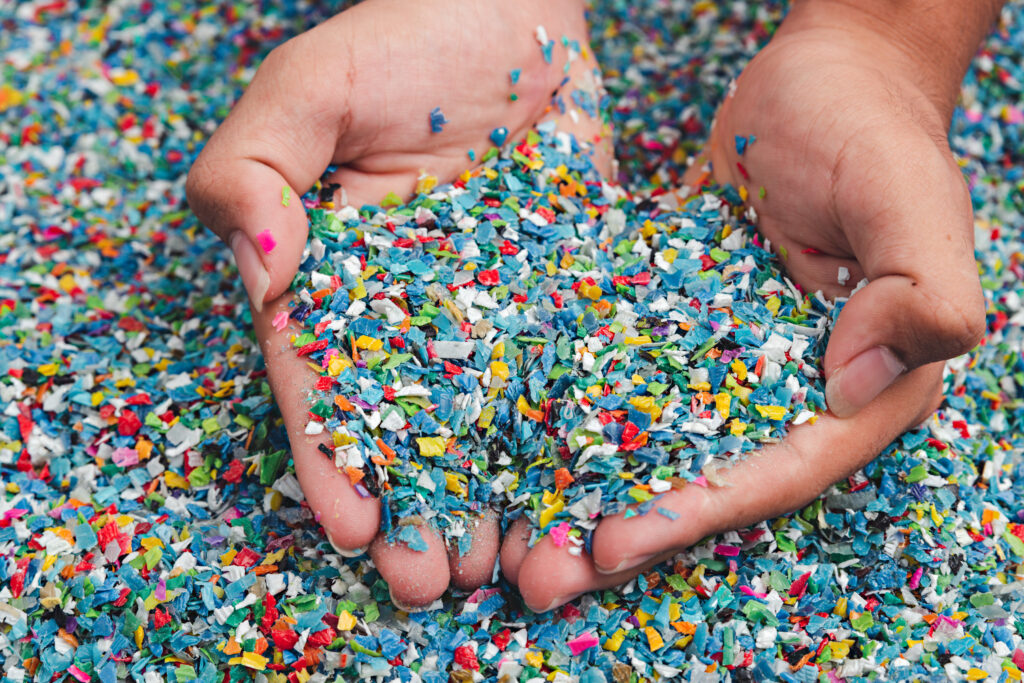
The question of whether to use recycled or virgin plastic is no longer a simple technical choice — it’s a defining sustainability decision.
For manufacturers like TP Plastic USA, finding the balance between performance and responsibility is key to building a truly circular production system.
By combining the precision of virgin resin with the innovation of recycled material, we’ve created a new standard in plastic packaging — one that meets both the strength your business demands and the sustainability the planet requires.
Table of Contents
Toggle1. What’s the Difference Between Recycled and Virgin Plastic?
At its core, the distinction lies in how the material is made:
|
Type |
Source |
Characteristics |
Common Use |
|---|---|---|---|
|
Virgin Plastic |
Produced directly from petroleum or natural gas feedstock |
Pure, uniform, high-clarity and consistency |
Medical, food-grade packaging, critical components |
|
Recycled Plastic |
Created from reprocessed plastic waste (post-industrial or post-consumer) |
Slightly variable color, texture, or clarity depending on grade |
Industrial packaging, trash bags, e-commerce mailers |
Virgin resin provides precision and performance.
Recycled resin provides circularity and environmental value.
The future of sustainable manufacturing lies where these two meet — in controlled, high-efficiency blends.
2. The Environmental Case for Recycled Resin
Using recycled resin directly reduces the environmental burden of plastic production:
♻️ Energy Savings: Manufacturing recycled resin uses up to 80% less energy than virgin production.
🌍 Carbon Reduction: Each ton of recycled resin prevents approximately 1.5–2 tons of CO₂ emissions.
🚯 Waste Diversion: Reduces landfill and ocean-bound plastic waste by re-introducing it into manufacturing cycles.
🔁 Circular Economy: Creates continuous material flow — no single-use endpoint.
For TP Plastic USA, using recycled resin isn’t a compromise — it’s an integral part of our closed-loop production model.
3. The Performance Advantage of Virgin Resin
Virgin resin remains essential where precision and purity are required:
Tight mechanical tolerances: Perfect for extrusion, sealing, and co-extrusion layers.
Optical clarity: Needed for transparent films and high-end packaging.
Regulatory compliance: Required for FDA food-contact and medical-grade applications.
By combining both resin types strategically, TP Plastic USA achieves the best of both worlds — sustainability without sacrificing strength, elasticity, or appearance.
4. How TP Plastic USA Blends Both Worlds
The secret lies in controlled resin engineering — using smart blending systems and data-driven extrusion.
Step 1 – Source Quality Resin
We procure recycled resins from certified GRS and ISO-approved suppliers, ensuring consistent melt flow, color, and density.
Step 2 – Test and Validate
Each batch is tested in our in-house lab for:
Melt Flow Index (MFI)
Tensile Strength
Elongation at Break
Color Consistency
Film Clarity
Only verified resin batches are used in production.
Step 3 – Blend with Precision
Automated dosing systems mix virgin and recycled resin in optimized ratios:
20–30% recycled content in PE stretch film inner layers
30–50% recycled content in trash bags
Up to 100% recycled resin in non-food packaging
Step 4 – Maintain Product Integrity
Advanced co-extrusion ensures recycled content is placed in non-critical layers — maintaining surface quality and tensile performance identical to virgin products.
5. Product Examples: Balancing Sustainability and Strength
a. PE Stretch Film
Our signature stretch film achieves exceptional clarity and load retention using a blend of virgin and post-industrial recycled PE.
It delivers:
400% tested elongation
Excellent puncture resistance
20–25% lower carbon footprint
→ Ideal for warehouse and logistics packaging.
b. LDPE Mailer Bags
For e-commerce packaging, recycled LDPE resin is integrated without compromising aesthetics.
Each mailer:
Contains 25–40% recycled content
Is recyclable under ASTM D7611 code #4
Uses solvent-free inks for printing
→ Certified sustainable packaging for Amazon, Walmart, and Shopify sellers.
c. HDPE/LDPE Trash Bags
Produced with up to 100% recycled resin, our trash bags showcase the circular potential of plastic.
The star-seal design eliminates seam waste, while high-tensile blends maintain durability.
→ Perfect for janitorial, industrial, and commercial applications.
d. TPE/CPE Gloves & Aprons
Even our disposable glove and apron lines follow the same logic — lightweight thermoplastic elastomers with minimal waste.
Cutting scraps are reprocessed for non-critical uses, making the system 100% waste-neutral.
6. Why Recycled Resin Doesn’t Mean Lower Quality
Modern recycling and compounding technology have eliminated most of the “old” performance gaps between virgin and recycled resin.
Through processes like melt filtration, deodorization, and color correction, recycled resin can now match — or even outperform — virgin material in certain applications.
TP Plastic USA continuously runs real-world tensile and clarity tests across blended resin batches, proving that sustainable packaging can perform at the highest industrial standards.
7. The Economic Advantage of Hybrid Resin Systems
Beyond sustainability, blending recycled and virgin resin creates measurable economic benefits:
Cost Efficiency: Reduced virgin resin usage lowers raw material cost.
Price Stability: Recycled resin buffers against global resin price fluctuations.
Supply Security: Multiple resin sources mitigate supply-chain risks.
Market Competitiveness: Sustainability credentials add brand value for distributors and retailers.
By maintaining performance parity while reducing environmental impact, hybrid resin systems redefine manufacturing efficiency.
8. Compliance and Traceability: Building Buyer Confidence
All TP Plastic USA materials and blends comply with global standards:
|
Standard |
Purpose |
|---|---|
|
ISO 9001 / 14001 |
Quality and Environmental Management |
|
GRS (Global Recycled Standard) |
Verifies recycled content and sourcing |
|
ASTM D7611 |
Identifies resin type for recyclability |
|
FDA 21 CFR |
Ensures food-contact safety |
|
REACH / RoHS |
Confirms compliance with EU chemical restrictions |
Through documentation and batch tracking, our OEM and wholesale partners can verify every product’s material composition and sustainability level.
9. The Real-World Balance: Strength Meets Sustainability
Finding the balance between recycled and virgin plastic is not a trade-off — it’s an optimization process.
For TP Plastic USA, that means:
Virgin resin where precision matters.
Recycled resin where circularity adds value.
Smart engineering in between.
Every blend, every roll, and every bag is a result of data-driven calibration — achieving performance that customers can rely on, and sustainability they can believe in.
10. Looking Ahead: Toward 100% Circular Material Systems
As recycling technology evolves, the line between virgin and recycled plastic continues to blur.
Future developments we’re investing in include:
Chemical recycling to regenerate plastic at a molecular level.
Bio-based polymer integration for carbon-neutral packaging.
AI-driven resin optimization for perfect blend ratios with zero variability.
Our long-term goal:
Every product made by TP Plastic USA will be fully recyclable, traceable, and circular by design.
Conclusion: A New Standard of Balance
At TP Plastic USA, the debate between recycled and virgin plastic is over.
The answer is balance — blending the purity of virgin materials with the purpose of recycled ones.
From stretch films and mailer bags to trash bags and gloves, we’re proving that performance and sustainability can thrive together.
Because the strongest packaging isn’t just durable —
It’s responsible.


