


Stretch film is a daily-use material in warehouses, fulfillment centers, and distribution operations. While many businesses start with hand stretch film, growth often raises a critical question:
Does switching to machine stretch film actually save money—or just add equipment cost?
The answer depends on volume, labor, consistency, and film efficiency, not just roll price. This article compares hand stretch film vs machine stretch film across real operational factors to determine which option saves more cost—and when it’s time to switch.
Understanding the Two Options
What Is Hand Stretch Film?
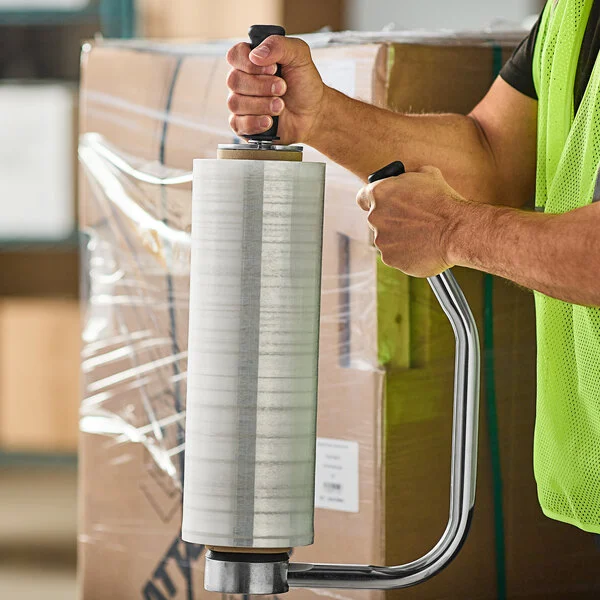
Hand stretch film is designed for manual pallet wrapping. It’s applied by operators walking around the pallet, pulling tension by hand.
Typical traits:
-
Shorter roll lengths
-
Lower stretch capability
-
Minimal upfront investment
-
Flexible for irregular loads
Best for low to moderate volume environments.
What Is Machine Stretch Film?
Machine stretch film is engineered for automatic or semi-automatic wrapping machines. Tension and stretch are controlled mechanically.
Typical traits:
-
Longer rolls
-
Higher stretch percentages
-
Consistent wrap force
-
Faster throughput
Best for medium to high volume operations.
Cost Isn’t Just the Roll Price
A common mistake is comparing roll price alone. True cost includes:
-
Film used per pallet
-
Labor time
-
Load failures
-
Rewraps and damage
-
Throughput limits
Savings come from system efficiency, not the cheapest roll.
Film Usage Per Pallet
Hand Stretch Film
-
Lower pre-stretch (often 50–100%)
-
Inconsistent tension by operator
-
More film used to achieve stability
Result: Higher film consumption per pallet.
Machine Stretch Film
-
Controlled pre-stretch (150–300%+)
-
Uniform wrap patterns
-
Less film needed for the same load
Result: Lower film usage per pallet, consistently.
Labor Time & Throughput
Hand Wrapping
-
Operator walks around pallet
-
Physically demanding
-
Slower per pallet
-
Variability between operators
As volume grows, labor becomes the largest hidden cost.
Machine Wrapping
-
Automated cycles
-
Faster wrap times
-
Minimal physical strain
-
Predictable output
Machines free labor for higher-value tasks.
Consistency & Load Stability
Inconsistent wrapping causes:
-
Shifting loads
-
Product damage
-
Rewraps
-
Safety risks
Hand Film
-
Depends on operator strength and technique
-
Hard to standardize
Machine Film
-
Fixed settings
-
Repeatable results
-
Better load containment
Consistency reduces downstream costs like returns and claims.
Stretch Capability & Film Performance
Machine film is formulated to:
-
Withstand high stretch
-
Recover elastically
-
Hold loads tighter with less material
Hand film cannot safely reach these stretch levels, limiting efficiency.
When Hand Stretch Film Makes Sense
Hand film is cost-effective when:
-
Pallet volume is low
-
Wrapping is occasional
-
Loads are irregular
-
Capital investment isn’t justified
For small operations, hand film offers flexibility without commitment.
When Machine Stretch Film Saves More Cost
Machine film saves money when:
-
Pallet count is consistent and rising
-
Labor cost matters
-
Load stability is critical
-
Film usage needs control
At scale, material + labor savings quickly outweigh equipment costs.
A Simple Break-Even Mindset (Conceptual)
Instead of a fixed number, consider:
-
How many pallets/day?
-
How many minutes per pallet?
-
How often do loads fail or need rewrap?
-
What’s the labor cost per hour?
If wrapping is a daily, repetitive task, machines usually win.
Equipment Cost vs Operating Cost
Machines require:
-
Initial purchase
-
Space
-
Basic training
But they reduce:
-
Film waste
-
Labor fatigue
-
Injury risk
-
Inconsistent wrapping
Over time, operating savings often offset capital cost.
Safety & Ergonomics
Hand wrapping increases:
-
Back strain
-
Repetitive motion injuries
-
Fatigue-related errors
Machine wrapping improves:
-
Operator safety
-
Workplace ergonomics
-
Long-term productivity
Safety improvements carry real cost benefits.
Mixed Operations: A Practical Approach
Many facilities use:
-
Hand film for odd pallets
-
Machine film for standard loads
This hybrid strategy balances flexibility and efficiency.
Buying Film Wholesale: Amplifying Savings
Wholesale sourcing allows:
-
Consistent film specs
-
Optimized thickness for machines
-
Lower cost per foot
-
Reliable inventory
Machine film benefits most from wholesale optimization due to volume.
Common Mistakes to Avoid
-
Delaying machine adoption too long
-
Comparing only roll prices
-
Using hand film on machines (or vice versa)
-
Ignoring labor and safety costs
Correct matching prevents silent cost leakage.
Final Verdict: Which Saves More Cost?
-
Low volume, flexible needs: Hand stretch film
-
Consistent, growing volume: Machine stretch film
At scale, machine stretch film saves more cost through lower film usage, reduced labor, better consistency, and fewer failures. Hand film remains valuable—but mainly as a flexible tool, not the primary solution.


